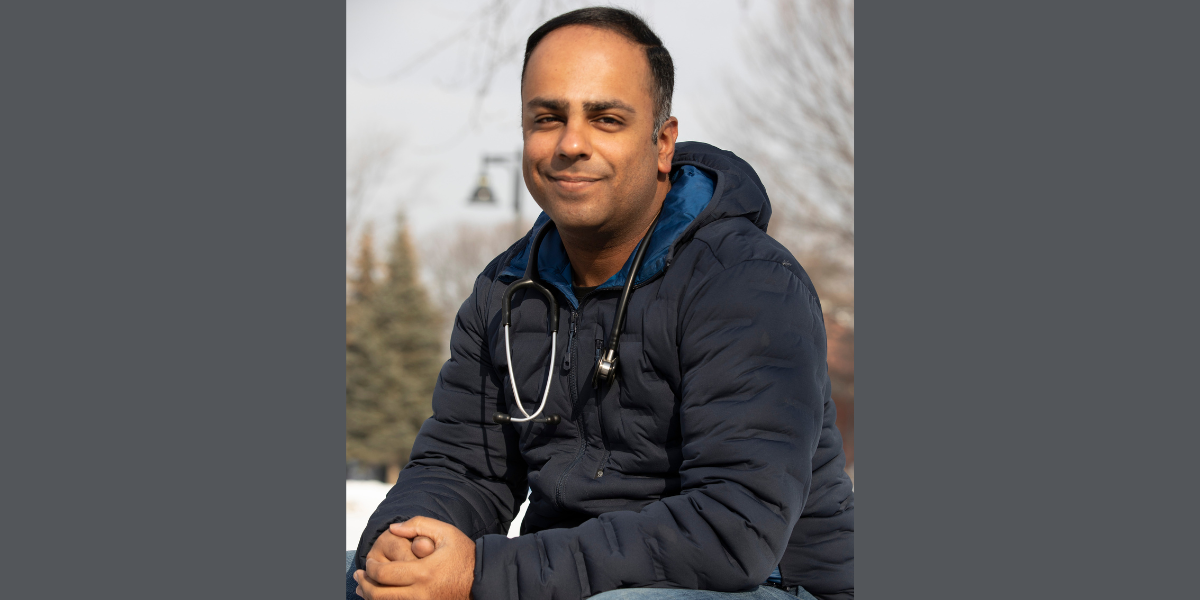
Igniting health justice for unhoused people

As the child of refugees who struggled to access healthcare in Toronto, Dr. Naheed Dosani always knew he wanted to inspire social change through a career in medicine.

But he can pinpoint the exact moment he chose to dedicate his life to health justice in the field of palliative care.

During his residency, he found himself caring for a man named Terry who was experiencing homelessness, substance use, and a serious mental health condition. Terry had also been diagnosed with terminal neck cancer.

“He hadn’t been able to get the care he needed, and he died a very agonizing, painful death in the shelter,” says Dr. Dosani. “That experience changed me forever.”

Although the health system has long recognized the importance of palliative care, Dr. Dosani—who is now a palliative care physician and researcher at St. Michael’s Hospital—says that people experiencing homelessness often lack access to it.   

“Palliative care can be a really beautiful thing that enables a peaceful passing for those who receive it. But shelter-based palliative care is not something our system is able to deliver,” he says.

“This means that when they’re dying, people in the shelter system can experience significant pain, existential distress, and frequent transfers to the emergency department.”

Yet they are also far more likely to face life-threatening health issues and die prematurely.

Unhoused people are five times more likely to have heart disease and four times more likely to have cancer compared to the general population. And their average life expectancy is just 34 to 47 years old. 

“We have to do a lot better if we truly believe in a human rights-based approach to palliative care,” says Dr. Dosani.

Leading change

For more than a decade, Dr. Dosani has been working to improve access to compassionate end-of-life care for people on the margins of society.

In 2014, he launched the world’s first mobile palliative care program for unhoused people with just his own car and the support of a street nurse.

Called PEACH, or Palliative Education and Care for the Homeless, the program now has a network of mobile clinics across Canada. It’s also been replicated in the United States, Australia, and other countries around the world.

“PEACH is a partnership between a number of different organizations that have come together in recognition of its urgent need, including Inner City Health Associates, Kensington Health, Ontario Health’s Toronto Central and Downtown East, and Unity Health Toronto,” says Dr. Dosani.

He’s also leading groundbreaking research as an investigator with the MAP Centre for Urban Health Solutions at St. Michael’s, Canada’s largest research centre focused on health equity and social determinants of health. A significant portion of the work taking place at MAP is funded by donor dollars.

“At MAP, we’re looking at how we can create models of palliative care that support equity for the unhoused population, the issues and gaps faced by community workers in connecting individuals with palliative care, improving guidelines around this work, and much more.”

He says that MAP has provided a truly innovative space for this work to happen.

“MAP is the pinnacle of anything and everything related to equity-focused solutions for complex health issues impacting vulnerable people,” he says. “Not only are we asking incredibly important questions at MAP that don’t get asked elsewhere, but it’s being done with expertise and care for the populations we’re working for.

And as co-chair of Improving Equity in Access to Palliative Care, an initiative funded by Health Canada, Dr. Dosani has overseen the delivery of $2.3 million to 23 projects across Canada focused on improving equity in palliative care.

“This work is really changing how we do things in the world of palliative care right across Canada, from mobile-based programs like PEACH to changes in paramedic practices to harm reduction approaches and beyond,” he says.

A more just and hopeful future ahead

As he pursues his vision of health justice, Dr. Dosani is driven every day by the stories of the people he’s cared for.

“I think of Pandora, a young woman who was struggling with substance use and dying of heart failure. Our team was able to allow her to die in a place where she was comfortable and cared for, surrounded by her street family,” he says.

There was Richard, an Indigenous man who was able to engage in his passion for soap sculpting before he passed away.

And Archie, a former engineer who found himself living in a men’s shelter before being diagnosed with terminal cancer. He loved to do the daily crossword at Allen Gardens, so the team would provide care for him in the park with his consent.

“I’m reminded that we must always remember to acknowledge the full dignity of each person beyond the stigma of their marginalization,” says Dr. Dosani.

Now, when he thinks of the future of palliative care in Canada, Dr. Dosani is optimistic.

“We’re seeing action and change. Public and philanthropic dollars are being invested in this work, and there’s recognition across the health system that this is important,” he says.

“I’m hopeful that in the future, people will face fewer structural barriers to care. They’ll live longer lives. And we’ll be a better and healthier society because of it.”

Preventable cold-related deaths take toll on Ontario’s homeless population, hospital staff

MAP scientist and director Dr. Stephen Hwang spoke with The Canadian Press about the spike in cold-related injuries among unhoused individuals during Ontario’s recent cold snap. St. Michael’s Hospital staff have worked with a local Toronto shelter to provide a warm and safe place for those who turned to the emergency room this winter.

This article was also featured on CTV News, CBC and Global News.

What Canada can learn from Costa Rica’s primary care system

Op-ed for Healthy Debate by Dr. Tara Kiran

I first read about Costa Rica’s primary care system nearly a decade ago. In 2016, I came across a paper by physician-researchers at Ariadne labs, including Madeline Pesec, describing how this small, middle-income country was achieving health outcomes that exceeded what its resources would predict – including lower infant mortality and longer life expectancy than the United States, and outcomes comparable to much richer countries.

What was at the heart of their success? A strong primary care system that’s integrated with public health. And an underlying ethos that health is a human right.

Through the 20th century, Costa Rica invested heavily in public health, including sanitation, clean water, nutrition – but also epidemiology and data collection. Clinicians and public health workers were expected to go to people rather than wait for patients to come to them.

Then in the 1990s Costa Rica made a key structural decision: it placed public health and health-care delivery under a single national social security agency. Prevention, primary care and hospital care are part of one system, accountable for health across the life course. When the agency invests in increasing physical activity in childhood, the same agency reaps the rewards of lower rates of cardiovascular disease in adulthood.

I remember reading Pesec’s article on Costa Rica and thinking how Canada could learn a lot from that approach, particularly the four pillars of their primary care system:

  1. Strong interprofessional teams. In Costa Rica, care is delivered through more than 1,300 EBAIS clinics (Equipos Básicos de Atención Integral de Salud), each serving roughly 3,000-5,000 people. Teams include a physician, a nurse or nursing assistant, a pharmacist or pharmacy technician, a data specialist and a community health worker (ATAP). Community health workers play a central role in building relationships and identifying populations at risk.
  2. Geographic empanelment. Costa Rica’s primary care teams are responsible for everyone living within a defined geography. Community health workers maintain a census of every household, mapped and stratified by risk. Every household is visited at least once a year, with more frequent visits for those with higher needs. Teams know exactly who they are accountable for.
  3. Integrating public health and primary care. Community health workers (or ATAP) act as a bridge between primary care clinics and the surrounding community. ATAPs lead health promotion efforts – delivering vaccines, monitoring health parameters, providing education on disease prevention – and connect people to clinical care when needed.
  4. Robust data and feedback loops. Data are embedded in daily work. Teams have chronic condition registries, for example, noting who in the community has diabetes or high blood pressure and whether they have received recommended testing. They also track vaccines, pregnancies, social risk and other data that can help them understand population health needs over time.

I should acknowledge that things aren’t perfect in Costa Rica. The country struggles with some of the same challenges we face in Canada, including fiscal and workforce pressures. But even under strain, it continues to achieve better outcomes than its level of spending would predict. Notably, research has shown that the introduction of EBAIS teams in Costa Rica was associated with substantial reductions in mortality over time, particularly among older adults and from cardiovascular disease.

In November 2024, I had the chance to visit Costa Rica. In recent episodes of my podcast, Primary Focus, I take listeners behind the scenes to see an EBAIS team in action and hear directly from the community health workers at the heart of their model.

One of my key takeaways: Costa Rica is a country with far fewer resources than we have in Canada – but much more ambition. It’s designed a system that takes care of everyone – regardless of their geography or background.

And although our countries are very different, there’s a lot we can learn from Costa Rica. I think each of Costa Rica’s four primary care pillars is applicable to the Canadian context.

Can we imagine a future where every person in Canada is “geographically empanelled” to a local interprofessional team that treats illness but is also connected to social services to support wellness and where data feedback loops drive continuous quality improvement? These are all critical elements of what people in Canada told us they wanted to see in a better primary care system.

Compared to Costa Rica, Canada has roughly twice the economic resources per person adjusted for cost of living. In other words, we have enough money. What we need is more ambition – to build a system where every person is accounted for and the responsibility of a healthcare team.

Editor’s note: A version of this article first appeared in The Medical Post.

$25M donation to establish new model for tackling homelessness in Toronto

The Slaight Family Foundation’s transformational gift allows MAP and the United Way Greater Toronto to launch the Slaight Family Housing Lab that will use an evidence-based approach to move people off the streets and into supportive housing. Dr. Stephen Hwang, MAP director and scientist, spoke with The Canadian Press about the launch.

“If we’re going to invest more funds, we need to invest them in long-term solutions, not in short-term Band-Aids,” he said. “That’s why this ($25 million) gift is so wonderful because it’s doing both of those things. It’s addressing urgent needs but it’s also creating long-term solutions.”

This article was also published in The Canadian Press, CBC, CTV Toronto and CityNews Toronto.

‘Transformational.’ Wealthy donor announces $25 million for a lab to fight Toronto homelessness

The newly created Slaight Family Housing Lab will pair MAP’s research on health equity and homelessness with the United Way’s role in funding community organizations that work with people surviving on Toronto’s streets, in encampments and beyond.

MAP director and scientist Dr. Stephen Hwang spoke with the Toronto Star about how the new funding will help create new front-line teams, including case managers, peer workers, social workers and other medical professionals. Those teams will go out onto the streets and work on connecting people outside with health care, social supports and eventually housing.