
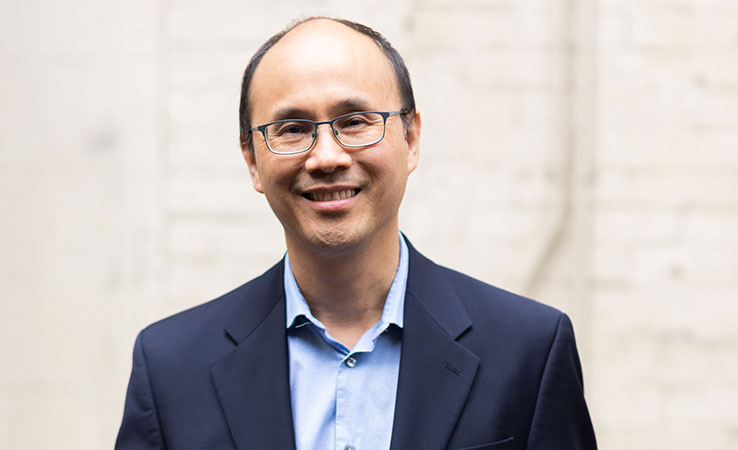
On June 30, 2026, Dr. Stephen Hwang will conclude his tenure as director of St. Michael’s Hospital’s MAP Centre for Urban Health Solutions, Canada’s largest research centre focused on health equity and the social determinants of health.
A world-renowned scientist and Tier 1 Canada Research Chair in Homelessness, Housing and Health, Dr. Hwang took on this role in 2015 and has now served the maximum of two five-year terms – plus one “bonus year,” as he jokingly calls it (his first term was extended due to the pandemic).
Although Dr. Hwang is leaving big shoes to fill as director, he isn’t going far. His research program will continue to be based at MAP under his leadership with a great deal of exciting work ahead.
Transformative, national impact
Dr. Hwang’s legacy as MAP director is nothing short of extraordinary. Under his leadership, MAP has more than doubled in size and quintupled in multi-year funding.
Despite pandemic-era research shutdowns and a major, unexpected change to the centre’s funding model, the centre has transformed from a largely Ontario-focused academic hub to a global leader in developing, implementing and scaling evidence-driven health equity solutions, with impacts that span from local to national and beyond.
Through it all, Dr. Hwang’s approach has been grounded in his commitment to “servant leadership,” supportive team building and above all, a deep respect for his partners’ and colleagues’ unique perspectives and experiences.
We talked with Stephen to reflect on his eventful and impactful decade in the role.
Q: Looking back over the past 11 years, what are some highlights that you’re most proud of?
When I started in the role, MAP had just lost our core provincial funding. We had to quickly pivot to a philanthropic model, but it wasn’t clear how to do that. Working with the St. Michael’s Foundation and their incredible volunteers to get that first fundraising campaign off the ground, and realizing that there was indeed donor interest with the potential to sustain MAP, was a big moment. It felt like a huge turning point for the organization.
Our Solutions for Healthy Cities symposia were also major highlights for me. They have all been so inspiring, and great to be together in person.
I’m thankful and extremely proud of our national Even the Odds partnership with Staples Canada and how it’s grown, thanks to Staples’ leadership and vision. It has pushed MAP to get even more ambitious about our geographic reach and impact, and enabled us to scale our work in ways we could only have dreamed of 10 or 11 years ago.
Finally, I wouldn’t call it a highlight, but leading the centre through the pandemic was an honour. It was an extremely difficult time, but we pulled together at MAP and pivoted very quickly to fill an urgent need for research on COVID-19 and how to improve access to care and support during lockdowns.
Q: What’s been the hardest part of the job?
My first instinct is to always be as egalitarian and non-hierarchical as possible as a leader and to practice servant leadership. However as director, I also had to learn that sometimes a leader must make tough decisions based on their own best judgment. There are some decisions you can’t take a vote on, and also some decisions that not everyone will agree with. In those situations, I reflected on MAP’s and my own values and principles, I thought very carefully about appropriate and fair processes, and I sought the advice of wise counsel. Those things were all very helpful, but it was still something I had to learn to do.
Also, back to the pandemic – that was definitely hard. Our people at MAP were dealing with so much. For me, oddly, between leading MAP and working as a general internist at the hospital, the most straightforward part of the pandemic was my work taking care of patients with COVID. That part was squarely within my professional experience. At MAP, I had to figure out how to support our people who were struggling in all sorts of different ways, because of other stresses that the pandemic was causing. That part was much more complex.
Overall though, I have to say, it’s been a really wonderful 11 years. Some of our challenges have moved us forward to a better place. For example, looking back, I really believe that the transition to philanthropic funding made our research better. Many of our donors are leaders in the private sector. They ask us tough questions and challenge us in important and ultimately very positive ways. We were always impact-focused at MAP, but through our dialogue with donors we have had to get crystal clear on exactly how our work is helping people.
Q: What’s next for you?
My MAP research program has just launched a major partnership with United Way and the City of Toronto called the Slaight Family Housing Lab. Together, we were extremely fortunate to receive a $25 million gift from Gary Slaight and the Slaight Family Foundation to fund the development of a new, scalable, evidence-based system to move people from streets and encampments into supportive housing. I’m really excited about the potential impact. It’s going to be a huge focus for me in the coming years, and I believe it will lay the groundwork for similar work across the country.
Leading MAP has been a tremendous honour. I’m so happy to continue to be a part of it.